Working from Lanzarote in Winter: A Host's Guide
A January working day in London starts dark, ends dark and gives you about an hour of weak grey light through the office window. A January working day in Costa Teguise starts at sunrise around 07:40, ends at sunset at 17:59 and has ten hours of strong Atlantic sun in between. The work itself is the same. Everything around it changes.
We live in Costa Teguise and host Casa Los Alisios, a 3-bedroom villa five minutes from Lidl and ten from the closest beach. A good share of our winter guests are remote workers escaping a Northern European winter for four to eight weeks. This is what their working day actually looks like, and what we have learned about making a winter workation in Lanzarote work practically rather than as a brochure idea.
For the broader island-wide view (visa, costs, neighbourhood comparison, coworking spots), see our complete Workation Lanzarote guide. This post is the seasonal piece: weather, daylight, working day shape, and what changes between November and March.
What does Lanzarote weather actually do from November to March?
The numbers, averaged across recent years and pulled from Climates to Travel:
| Month | High | Low | Sea | Rainfall |
|---|---|---|---|---|
| November | 24.4°C | 17.5°C | 21.4°C | 15 mm |
| December | 22.0°C | 15.5°C | 20.1°C | 20 mm |
| January | 21.0°C | 14.2°C | 18.9°C | 15 mm |
| February | 21.5°C | 14.4°C | 18.2°C | 15 mm |
| March | 22.9°C | 15.2°C | 18.2°C | 10 mm |
A few things to take from the table. The high-low spread is narrow: roughly 7°C between midday and night. The sea cools more slowly than the air, so November still feels swimmable and even February is warmer than a heated UK indoor pool. Rainfall is concentrated into a handful of days each month, which usually means one or two grey afternoons and the rest dry.
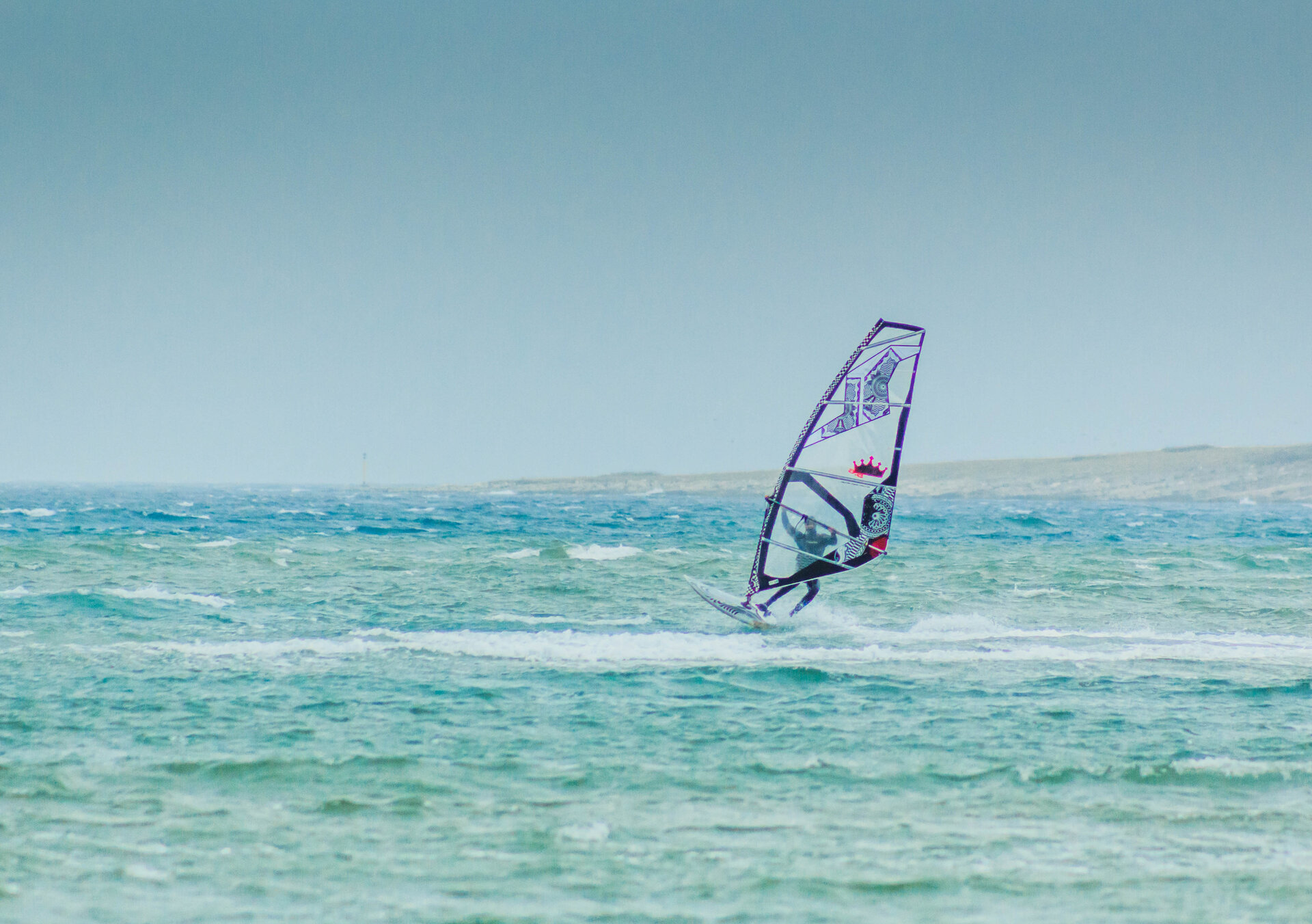
The other detail not in the table is wind. The summer trade winds from the north-east drop off through November and stay mild until April. The Las Cucharas end of Costa Teguise still picks up the windsurf-friendly breeze, but the side streets and our villa community sit in a wind shadow most winter days. Working with the patio doors open is normal from October through April.
How does the time zone work for UK and EU remote workers?
This is the single biggest practical reason Lanzarote works for European remote work and Madeira or the Caribbean do not without a meeting reshuffle. The Canary Islands run on Western European Time (WET), the same zone as the UK, Ireland and Portugal. That is UTC+0 in winter and UTC+1 in summer. Daylight savings shifts on the same day as the UK, so the offset never wobbles.
In practice this means:
- A 09:00 standup in London is a 09:00 standup in Costa Teguise. No half-hours, no calendar warnings about local time.
- A team in Berlin, Madrid or Paris is one hour ahead. You finish your day at 17:00 and they are wrapping up at 18:00.
- A team on the US East Coast is five hours behind. Their working day overlaps with your afternoon, the same as it would from London.
- The local working week is Monday to Friday and most cafés and supermarkets keep similar hours to the UK.
The other side of this: because the working day stays familiar, the lifestyle change comes from outside the working day. You finish at 17:00 and walk to a beach instead of to a bus stop in the rain.
Where I actually work from in winter
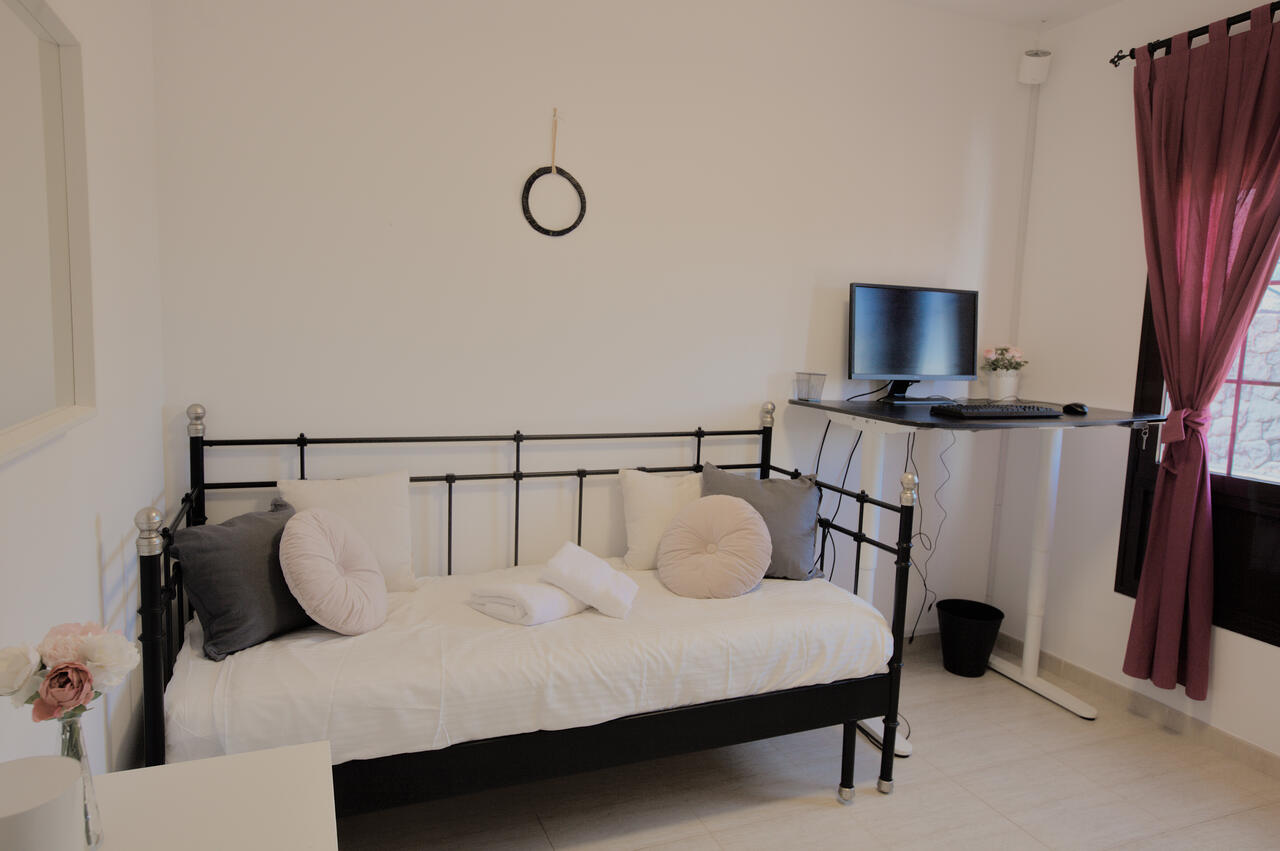
Most working days happen at the villa. The home office at Casa Los Alisios is built around a motorised sit-stand desk, an Ikea Markus chair, Cat6 ethernet at the desk and the 1 Gb fibre mesh. In winter the room needs no heating and no air conditioning. Daytime indoor temperature sits around 20°C even when the wind picks up outside, and the fans we use in summer go in the cupboard for four months.
What changes in winter is what happens around the desk:
- Morning admin from the terrace. December and January mornings start cool, around 14 to 16°C at 08:00, then climb past 19°C by mid-morning. The patio table works for the email-and-Slack first hour with a jumper on. By 10:30 it is shirt-sleeve weather.
- Deep work indoors. The studio bedroom has a closed door, natural light and is the quietest room in the house. This is the four-or-five-hour deep work block.
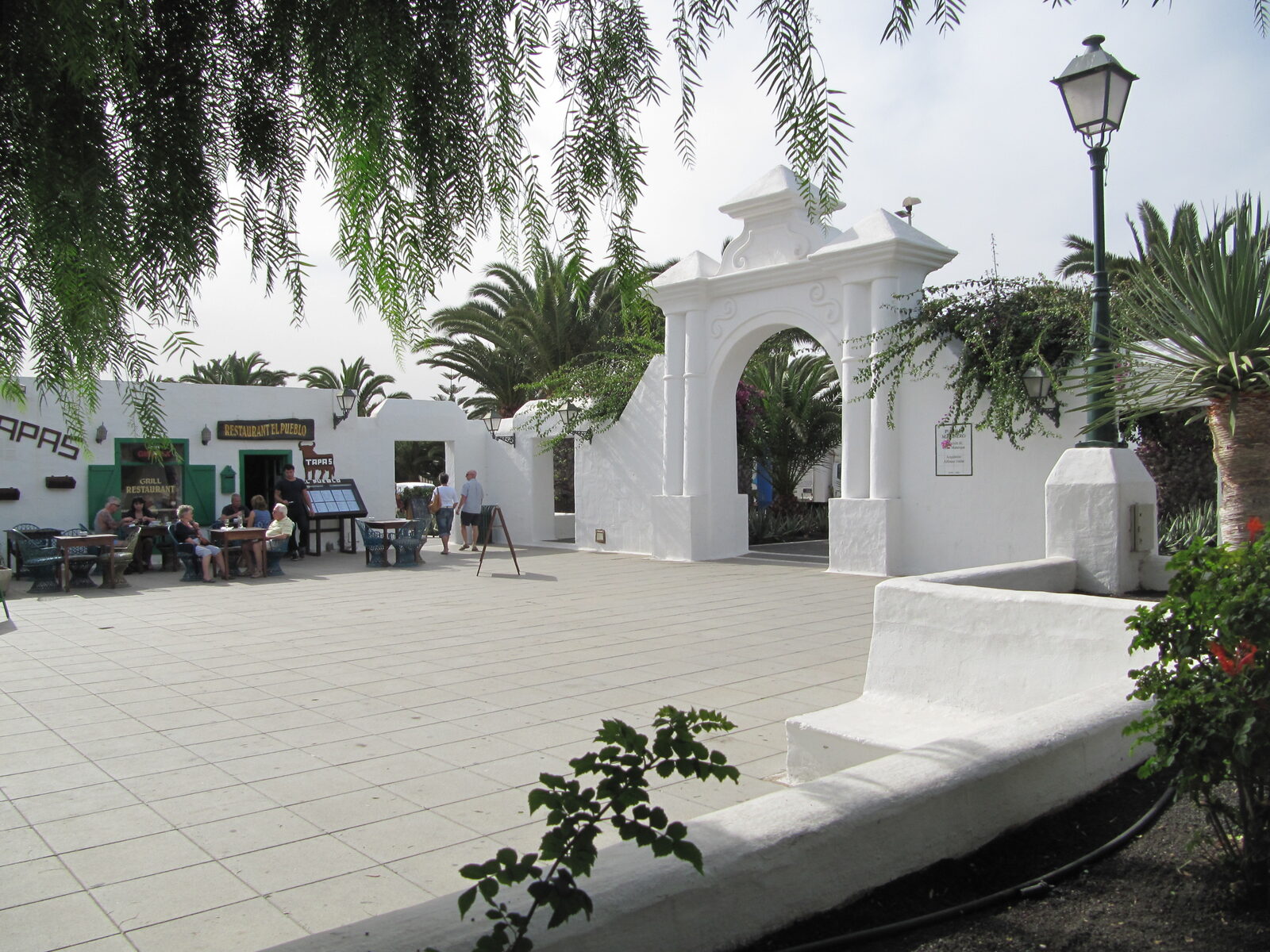
- One day a week from a café. Pueblo Marinero, a 30-minute walk or 5-minute drive from the villa, has cafés around a white-walled plaza that take laptop workers. The plaza is pedestrianised with shaded café terraces and is rarely full midweek between November and February.
- A coworking day if you need one. Coworking Guru in Teguise town is 10 minutes by car. The Square Coworking in Arrecife is 15 minutes. Neither is in Costa Teguise itself, so most of our workation guests use the in-villa office daily and the coworking spaces as a once-a-week change of scenery.
The Costa Teguise digital nomads guide goes deeper into the neighbourhood-level logistics if you want a longer read on the base.
What I do on lunch breaks and after work
The honest answer to “what is different about working from Lanzarote in winter” is the breaks, not the work. A 45-minute lunch from December through February looks like this:
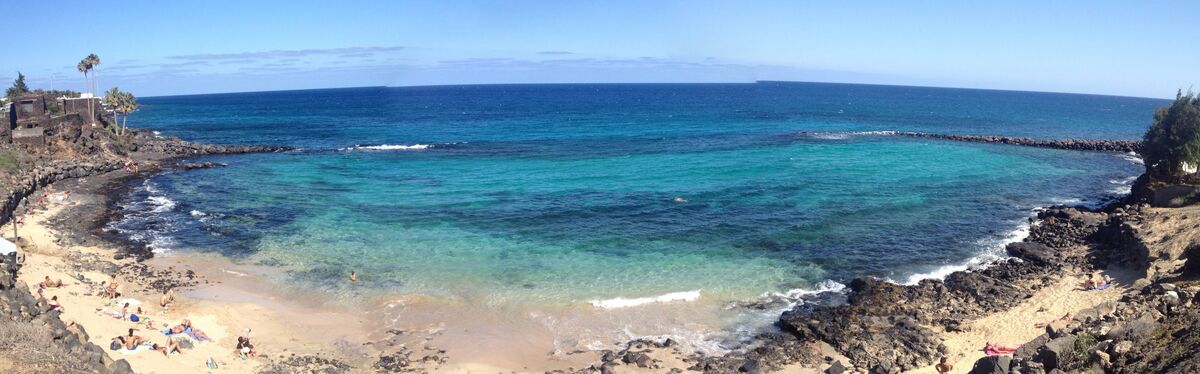
- A 10-minute walk to Playa El Ancla and a swim. The bay is sheltered from the north wind by a low headland, the rocky entry deters crowds, and the sea is 18 to 20°C through the season. Get directions from Casa Los Alisios
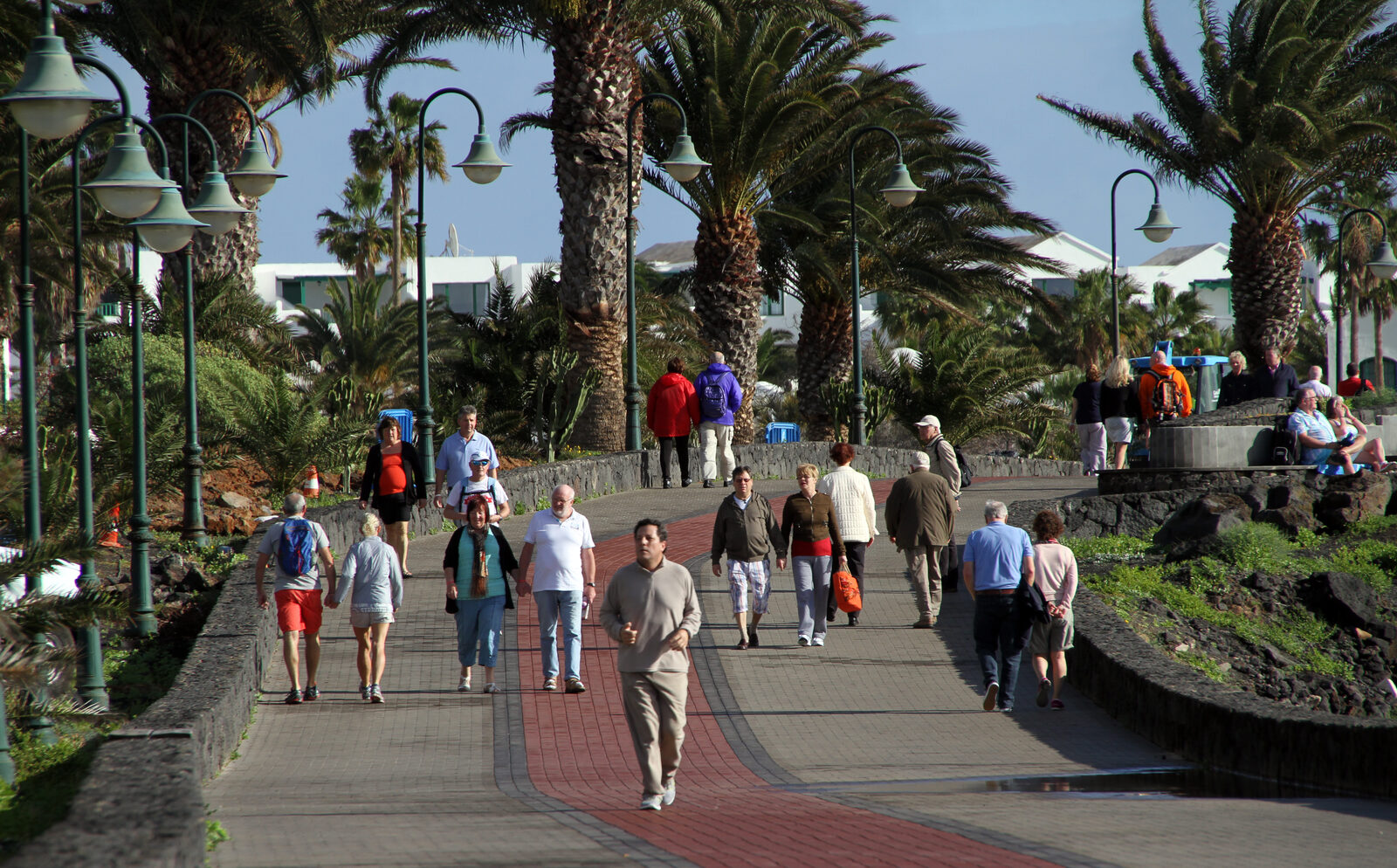
- A flat 20-minute walk along the seafront promenade to Las Cucharas and back. Coffee at the windsurf-school café on the way.
- A drive up to Mirador del Río with a packed lunch if you have a longer break. About 30 minutes each way, 475 m drop to the La Graciosa channel from the lookout.
After work changes shape because the sun sets earlier. Through December and January sunset is between 17:55 and 18:15, so the working day ends with golden hour rather than after it. That means dinner happens at home more than out, the kitchen and the 86-inch living-room TV get used more, and the walks from Costa Teguise tend to be morning or weekend rather than evening.
How does a winter month in Lanzarote compare with a UK winter month on cost?
The cost comparison breaks down differently than people expect. Here is what changes:
- Heating, gone. A typical UK three-bedroom house in December and January runs 100 to 200 GBP in gas a month. The villa needs none.
- Groceries, broadly similar. Spar (3 minutes’ walk), Lidl (5 minutes), Hiperdino and SuperDino cover most needs. UK staples are stocked. Fresh produce is cheaper than the UK, alcohol much cheaper. Full breakdown in our Costa Teguise supermarkets guide.
- Eating out, cheaper. A menu del día (set lunch) at a Spanish bar in Costa Teguise or Arrecife runs 10 to 14 EUR for two courses plus a drink. The equivalent UK pub lunch is closer to 18 GBP.
- Coffee, half the UK price. A flat white in Costa Teguise is 1.80 to 2.50 EUR.
- Flights, cheap mid-week. Ryanair, easyJet and Jet2 fly direct to Arrecife (ACE) from most UK airports. November to early December and mid-January to mid-February are the cheapest weeks. Tuesday and Wednesday departures save 30 to 50% over weekend flights.
Add a long-stay villa rate to that picture and a winter month working from Lanzarote often costs the same as or less than the same month working from a heated UK home.
When to come and how long to stay
The four winter months have distinct flavours:
- November. The warmest of the off-season at 24°C average highs. Sea still feels summery. School half-term week is busy, the rest of the month quiet.
- December. Shortest days, festive without being overwhelming. The villa community quietens by mid-month and stays quiet until 6 January (Reyes Magos).
- January. Coldest, quietest, cheapest. Long evenings push you inside, which suits deep-work months. Triathletes start arriving for IRONMAN Lanzarote training blocks toward the end of the month.
- February. Mid-twenties on sunny days, occasional grey afternoon. Half-term again brings UK families.
- March. Shoulder-season warmth returning, sea still cool, longer evenings.
Length of stay matters more than which month you pick. A week is a holiday with a laptop. Four weeks is a workation: long enough for a routine to settle, for the gym membership and the coffee-shop habit to start paying back, and for flights to become a smaller per-day cost. Most of our winter workation guests book three to six weeks.
How do I get to Costa Teguise from the UK in winter?
The villa is 15 minutes by car from Arrecife airport (ACE). Direct winter flights from the UK:
- Ryanair flies from London Stansted, Manchester, Birmingham, Bristol, East Midlands, Edinburgh and others.
- easyJet flies from London Gatwick, Luton, Manchester, Bristol and others.
- Jet2 flies from most regional airports.
- TUI runs charter flights that sometimes have cheaper seat-only fares.
Flight time is 4 to 4.5 hours from London. A pre-booked transfer or taxi to Costa Teguise is around 25 EUR. The local bus from the airport runs to Arrecife and you change there, which is doable but not worth saving the cab fare on the first day with luggage.
If you are flying from continental Europe, Madrid, Barcelona, Berlin, Frankfurt, Amsterdam, Brussels and Dublin all have direct or one-stop options most winter weeks.
The honest summary
Working from Lanzarote in winter is not the digital-nomad fantasy of a beachside laptop in a hammock. It is a familiar working day in unfamiliar weather. UK time zone, fibre internet, a desk built for an actual eight-hour day, and 21°C and sun where you are used to 7°C and rain. The shift is in the breaks, the commute (zero), and the heating bill (zero). Once you have done a winter month from Costa Teguise once, the November-to-March stretch starts looking like the part of the year worth optimising for.
If you want to read the villa setup in detail before booking, the workation villa tour walks through the office, the connectivity and the room layouts. If you want the location guide for Costa Teguise itself, the digital nomads post is the read. And if you are planning to bring family along with the laptop, the best beaches in Costa Teguise and walks from Costa Teguise cover what the non-working half of the household will do.
Frequently Asked Questions
- What is the temperature in Lanzarote in winter?
- Winter highs run 21 to 22°C from December through February, with overnight lows of 14 to 15°C. Sea temperature stays between 18°C and 20°C across the four months. The island has a hot desert climate and gets roughly 15 to 20 mm of rain a month over only two or three days, so most of any given week is dry.
- Does Lanzarote use the same time zone as the UK?
- Yes. The Canary Islands run on Western European Time, the same zone as the UK, Ireland and Portugal. That is UTC+0 from late October to late March and UTC+1 in summer. Daylight savings shifts on the same date as the UK, so a London-Lanzarote working day overlaps for the full Monday to Friday with no time-zone math.
- Is the WiFi reliable enough for remote work from Lanzarote in winter?
- Fibre is widely available across Costa Teguise. Casa Los Alisios has 1 Gb fibre into a TP-Link Deco mesh that reaches every room, a Cat6 ethernet port at the desk and a backup connection that takes over if the main line drops. Winter has the same fibre speeds as summer. Mobile 4G and 5G coverage in town is strong if you need a hotspot.
- When is the rainy season in Lanzarote?
- Most of the island's small annual rainfall, about 110 to 120 mm a year, falls between November and February. Even in those months it averages 15 to 20 mm spread across two or three days. A wet week is rare. Trade winds are also calmer in winter than in summer, which makes the working environment quieter on the south coast.
- What is the best month for a winter workation in Lanzarote?
- November and March give the warmest temperatures of the off-season, around 23 to 24°C. December has the shortest days and a quiet, festive feel. January is the coldest and quietest month and tends to be the cheapest to fly into. February has reliable mid-twenties weather on sunny days. For a routine to settle, stay four weeks rather than one.
Planning your trip? Book Casa Los Alisios